


If you’re a real news junkie, you may have caught wind of the Trump administration’s unprecedented assault on higher education—banning DEI programs, withdrawing billions in funding, and limiting international enrollment. Universities have become a bastion of anti-Trumpism, and the president and his supporters view academics as self-satisfied elites begging to be humbled.
In October, the administration sent a Compact for Academic Excellence in Higher Education to nine elite universities, later extending it nationwide. Federal funding came with a new price. Section 3 requires meritocratic hiring, ending “reverse-discrimination” on the basis of sex, race, ethnicity, and other identities. For many academics, this demand made the Compact a nonstarter.
And yet affirmative action in faculty hiring is less secure than many of us assume. In part, that’s because we rarely subject it to serious scrutiny. As with other progressive shibboleths, arguments for the policy are often treated with kid gloves, arguments against it cast as beyond the pale. What if we don’t actually know, in any rigorous way, whether it does what its advocates say? What if the policy harms marginalized candidates more than it helps?
I ask these questions as a left-of-center professor inside the academy, broadly sympathetic to diversity—and as a person of color who for all I know benefited from affirmative action (or was disadvantaged by it, as a man). Personal experience tells me that such questions can provoke discomfort, even anger. (An acquaintance once asked, with more than a trace of hostility, whether I would resign if I discovered that I was a diversity hire.) But to earn our support, affirmative action must withstand the sort of criticism we usually reserve for opponents’ policies.
What Is Affirmative Action?
First, let’s get clear on what it’s not. Affirmative action isn’t anti-discrimination, such as eliminating preferences for whites and men. It’s not outreach and recruitment. Nor is it expanding topics worth studying. All of these are justified, or can be. Remove identifying information from applications. Develop programs that diversify the applicant pool. Recognize important subfields that privileged scholars overlook.
Affirmative action is something else, something more controversial: treating race, gender, and other marginalized identities as positive considerations in hiring. Identity may count for a lot or a little, or only as a tie-breaker, or it may be treated as a necessary condition. In Canada, some academic jobs are advertised exclusively to Black or Indigenous scholars. Quotas and explicit rules are unpalatable in the U.S. where the practice is illegal and arguably violates the Civil Rights Act, so informal norms often prevail.
Earlier this year, I posted about this topic on social media, inspiring considerable vitriol. Some commenters insisted that the idea is harmful propaganda, of course no one is ever hired solely on the basis of race. (Yes, of course—you wouldn’t pluck a future colleague off the street, but identity can count within a pool of qualified candidates.) Others said that affirmative action is obviously justified, that questioning it is outrageous and harmful. Some embraced both points: “Affirmative action doesn’t happen, and it’s good that it happens.”
Does It Happen?
Every academic knows a few talented and accomplished white men who never made it in their field—people whose research profiles almost certainly would have translated into successful careers had they happened to check other boxes. But who knows? Maybe they interviewed poorly. Maybe they’re outliers.
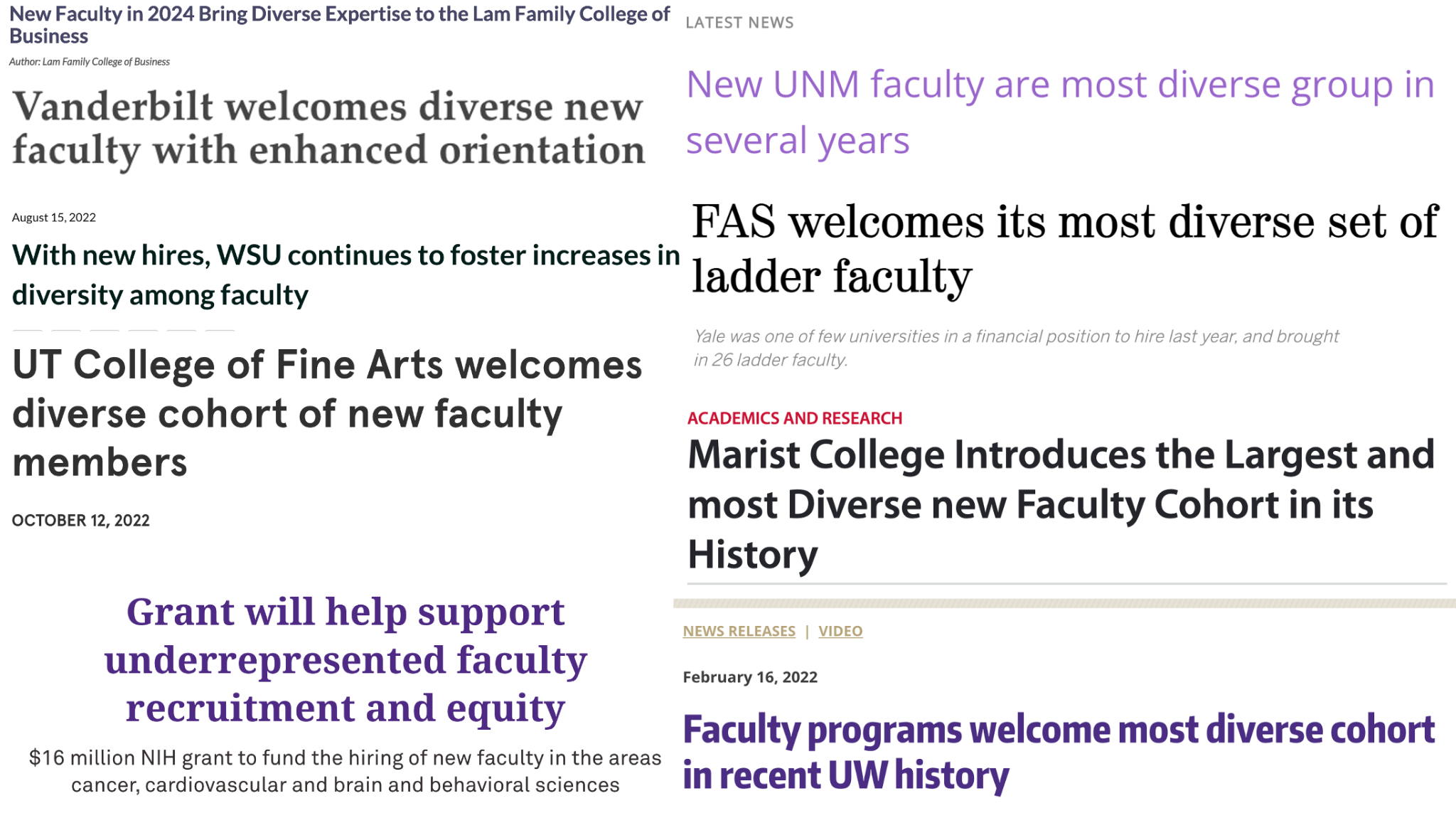
Some academics report being on hiring committees that covertly sought to hire a person of color or a woman. Universities are certainly trying to diversify their faculty, as their own press releases reveal, though this doesn’t tell us how the results were achieved.
Hard evidence is elusive. To evaluate whether marginalized identities give some candidates an advantage, you must hold merit fixed. That means brute differences in employment success won’t suffice: discrimination earlier in the process may select for the most determined and qualified scholars from marginalized groups.
Arguably, the best evidence for the existence of affirmative action comes from a 2023 adversarial collaboration, conducted by a team of researchers with opposing hypotheses about how common it is. Political ideology can drive motivated reasoning, leading researchers to find only what they go looking for. To guard against that, the team committed in advance to methods and standards of proof before scrutinizing hundreds of studies on gender bias in academia. This is exactly the kind of research we should want. And what does their meta-analysis show? No discrimination in grant funding, journal acceptances, and recommendation letters. Women do receive smaller salaries and worse teacher ratings. But when it comes to hiring, women on the job market have an edge over men with comparable qualifications.
Of course, this study tells us nothing about racial preferences. It’s hardly the whole story about gender. Nor does it provide a full picture of the challenges and prejudice faced by marginalized scholars throughout academia.
In philosophy, my own discipline, it remains an open secret that certain male faculty harass and abuse female graduate students. I know women who have been chased out of their graduate programs—or out of the field entirely. In all disciplines, women and people of color also experience more diffuse forms of discrimination, some of it resistant to empirical study. Such discrimination can pervade their academic history—through educational disparities, lack of mentorship, adverse social climates—and can show up again when they apply for full-time positions. In one study researchers gave biology and physics faculty otherwise identical CVs but altered the candidate’s name to manipulate perceptions of race and gender. Women and people of color were rated less competent and less hirable.
Many parts of academia remain homogeneous, but philosophy is exceptional. One survey found that philosophy and religious studies together were the least racially diverse academic field, with people of color making up only 14% of faculty. Another survey from the American Philosophical Association found that only 1-3% of philosophy faculty are Black, compared with roughly 14% of the U.S. population.
Yet the case for affirmative action isn’t about proportional representation, certainly not image management. It’s about justice and knowledge.
Justice
Some advocates think affirmative action enacts reparative justice—a form of reparations, especially for Black scholars historically disadvantaged by slavery, Jim Crow, and their enduring legacy. On this view, affirmative action benefits these marginalized groups and advances equity.
The problem is that it’s not effective. As Daniel Greco argues, present-day victims of historical injustice—those suffering from gaps in wealth, income, and incarceration rates—largely didn’t go to college, never mind graduate school. Thus, like other fashionable causes on the left—person-first language, corporate woke-washing—affirmative action in academia threatens to be purely symbolic rather than material. Other forms of reparations are far more effective, a better use of limited political capital: affirmative action lower on the socioeconomic ladder, health and housing equity, or universal forms of upliftment that disproportionately benefit Black people.
A different and better political argument for preferential hiring is that it enhances equality of opportunity. As just mentioned, marginalized groups experience discrimination throughout their educational history, from preschool to grad school. At the hiring stage, too, prejudiced committees underrate the quality of a candidate’s research. Affirmative action cancels out some of this discrimination, neutralizing unearned advantages of privileged groups. Rather than addressing past injustice, it counteracts present injustice.
It’s not just familiar categories of privilege—race, gender, class—that benefit some academics. Unearned advantages also accrue to the tall, attractive, or neurotypical. Or those blessed with extra rizz. (Guilty.) Perhaps hiring committees should prefer candidates who are short, unattractive, or neurodiverse.
In any case, affirmative action can be an effective way of restoring equality of opportunity, but it risks being a blunt tool. Those advantaged by it tend to be relatively privileged members of marginalized groups (like me). As with other forms of elite capture, opportunities go to people marginalized by race or gender but privileged by wealthy backgrounds or abundant social and cultural capital. A more targeted form of affirmative action could avoid this problem—one that also takes into account social and economic class.
But the argument from equality of opportunity faces another, graver risk: treating faculty positions unseriously, tantamount to make-work jobs. If academic work matters—if research matters, if teaching matters—then attenuating the academic meritocracy carries costs. In general, meritocracies are justified not in terms of desert or merit but by their positive effects on society—in academia, by selecting people best able to generate knowledge and with it, social welfare and freedom.
If the only effect of affirmative action is kneecapping more qualified candidates to equalize opportunity, then the practice reduces the quality of research and teaching. That’s true as well of proposals based on class instead of race or gender. At the margin, affirmative action can lead departments to hire and promote scholars whose work is of lower quality but who trade on their identity. The incentive is real—even tempting a few white scholars to misrepresent their race.
A common (and perhaps flatfooted) complaint about affirmative action is that it’s unfair. For advocates, local unfairness is justified because it advances broader equality of opportunity. But only if it avoids elite capture. And at the cost of reducing research and teaching quality? Not necessarily. As we’ll see, affirmative action in academia is not unfair if identity contributes to merit by improving research and teaching quality—if it advances knowledge.
Knowledge
Affirmative action can lead to cognitive diversity—the kind of diversity in perspective, background, and experience that opens up new ways of seeing problems and articulating solutions. In principle, diversity can even trump ability.
You don’t have to subscribe to standpoint theory to believe this. Even if marginalized identities confer no inherent epistemic advantage (they don’t), and all identities are equal (they are), you still want wide representation for the sake of cognitive diversity. This is particularly important insofar as science, technology, and policy have social impact. Research from marginalized groups is more likely to address the needs of people like them. As Jerusalem Demsas notes, evidence shows that when decision-making roles are women, other women benefit.
What’s more, a diverse faculty can provide superior teaching. Underrepresented faculty serve as role models for minoritized student populations. Research indicates that when Black students are assigned to Black teachers, they’re more likely than their peers to graduate from high school and attend college. Separately, diversity enhances teaching for the same reasons it enhances research—all students benefit by learning from those who inhabit a wide range of perspectives and backgrounds.
Elite capture is a risk here too. If departments hire faculty marginalized in one respect but privileged in others, their contributions to diversity may be quite limited. A wealthy Black professor may have far more in common with wealthy white people than with Black people from a wider socioeconomic spectrum. The solution is to attend to intersectionality, as Richmond Campbell and I argue in A Better Ape. Hiring committees should prefer candidates oppressed along multiple dimensions, particularly social and economic class. This would advance true cognitive diversity as well as equality of opportunity.
Are you sure you like these arguments? You should know what you’re signing on to: affirmative action based not just on race or gender but also political ideology. Conservatives are radically underrepresented among faculty, and hiring more conservatives would increase cognitive diversity and serve corresponding student populations. For example, greater political diversity in the academy might have interrupted the progressive groupthink that contributed to false consensus surrounding COVID policy. At most American universities, only a minority of students are conservatives, true, but the share among faculty is much smaller.
At this point, some advocates of affirmative action will be tempted to backtrack, seeking other justifications for the practice. But this is unmotivated. Conservatives don’t face the same educational barriers as people of color, but they do face discrimination in hiring. Moreover, when it comes to producing and disseminating knowledge, the arguments for demographic and viewpoint diversity are on a par, as Richard Y Chappell argues. Better to embrace the implications—though only where they genuinely apply. For example, ideological representation does contribute to cognitive diversity that improves research and teaching. Unlike Black and Indigenous people, however, conservatives in the population at large aren’t underserved by academic research with social impact.
Paul Bloom argues that hiring committees shouldn’t seek viewpoint diversity for its own sake—just more representation from worthwhile viewpoints, with diversity coming as a side effect. I agree, but academics have very narrow Overton windows, and they tend to underestimate the range of viewpoints that are worthwhile, while also underrating the value of productive disagreement. My own department has a pluralist tradition, and I was ecstatic a few years ago when we hired a philosopher whose political views fundamentally conflict with my own.
Problems
Even if the arguments from justice and knowledge can be defended and their implications embraced, serious problems remain: what affirmative action does to marginalized faculty, whether it undermines public trust in academia, and how little we know about its effects.
First and perhaps most damningly, affirmative action undermines the reputation of faculty from marginalized groups, even those who haven’t actually benefited from it. When the practice is common knowledge, it invites and rationalizes the idea that certain faculty are less competent. You can’t socially engineer status. The same goes for preferential hiring based on political viewpoints—colleagues of conservative scholars will make predictable and reasonable inferences about their competence.
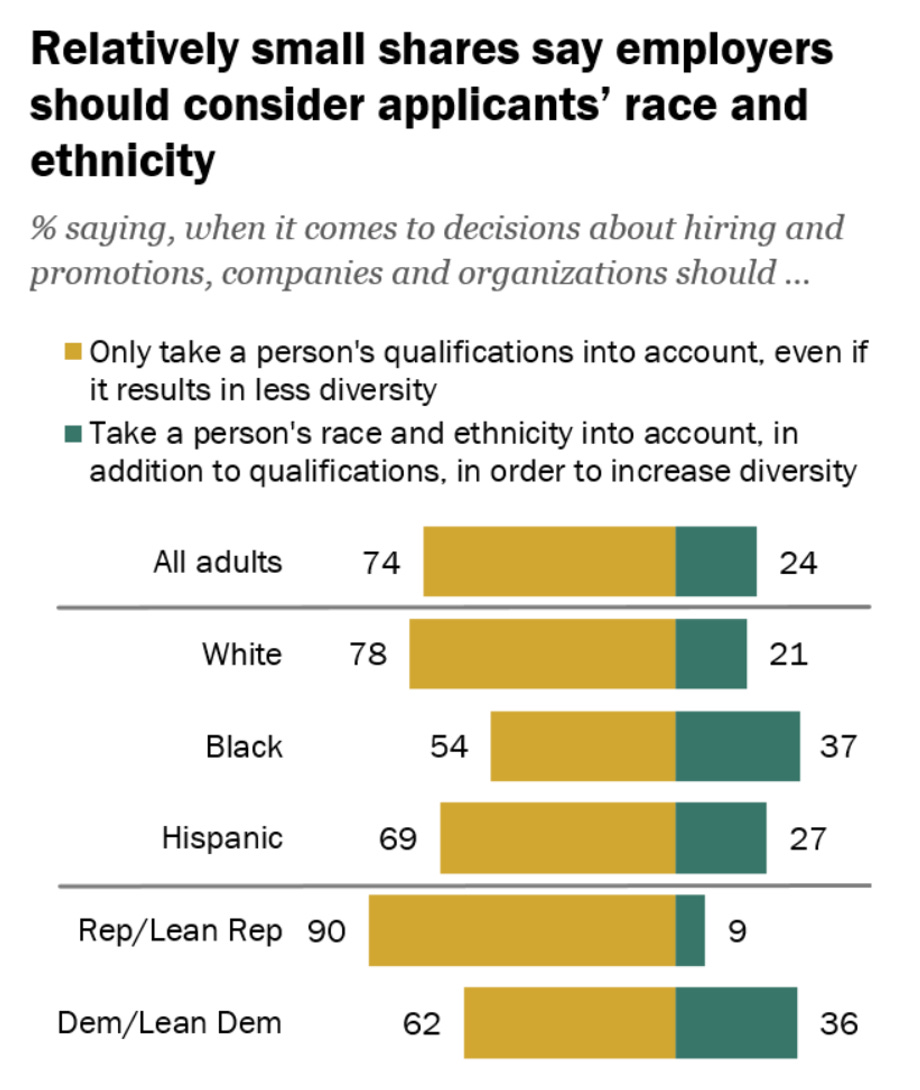
A second problem is damage to public trust. Across all forms of employment, affirmative action is deeply unpopular. According to Pew, nearly three-quarters of American adults believe that companies and organizations should consider only a person’s qualifications, even if less diversity results. This isn’t a narrowly partisan view; almost two-thirds of Democrats agree, as do more than half of Black people.
Now, if affirmative action contributes to research and teaching quality, then identity can in fact enhance a candidate’s qualifications—but the public may not buy this reasoning, especially when they believe (sensibly) that universities are motivated by PR rather than merit.
My focus has been on hiring, but many of these arguments apply to other forms of affirmative action in academia—involving promotion, leadership, and awards. For instance, Nature Reviews Psychology recently asked scholars to commit to “citation justice,” attesting to their effort to cite researchers from marginalized groups in statements accompanying their submissions. Is it worth it? On the one hand, it’s true that citation practices rely on social networks made up largely of privileged scholars (“old boys clubs”) and that high-quality research from marginalized scholars is often overlooked. On the other hand, the practice impugns the status of all such scholars who appear in resulting bibliographies, and it reduces public trust in science.
Evaluating all of these arguments and deciding which carry more weight isn’t just a matter of armchair moral argument; it requires testing many empirical claims. For example, the meta-analysis mentioned earlier suggests that women have an advantage over men at the hiring stage, but do Black and Indigenous scholars have an advantage over whites at this stage too? Does diversity really improve the quality of research and teaching? Does affirmative action undermine the reputations of marginalized scholars? Does it affect public trust?
All of this is fraught. Studies supporting affirmative action may be less trustworthy than they appear. Given the political biases prevalent in the academy, we should expect that researchers are biased to seek friendly evidence, and to ignore or fail to report unfriendly evidence. Beyond politically motivated reasoning, studies are plagued by small sample sizes, unreliable self-report, and far too many degrees of freedom in study design and analysis—like so much social science research. To even begin thinking clearly about any of this, we have to acknowledge that whether to pursue affirmative action in faculty hiring is an open question.
The gold standard is adversarial collaborations between researchers with different ideological commitments. Researchers who start out with opposing hypotheses agree in advance about methods and analysis—and then accept the results. As it turns out, viewpoint diversity is not just an awkward implication of arguments for affirmative action; it’s also necessary to credibly defend it.
Best Practices
The path to defending affirmative action in faculty hiring is narrow. Giving marginalized candidates an edge can promote equality of opportunity without any cost to research and teaching insofar as identity contributes to scholarly and educational merit. But current approaches are compromised by elite capture, reputational costs, and public distrust. The empirical evidence needed to fully support the policy, and to answer criticisms, has not yet been produced.
What, then, should universities do? They should of course make every effort to eliminate discrimination in hiring—anonymizing applications, for example. They should also expand their conceptions of topics worth studying, including minority viewpoints from across the political spectrum.
What else? Some argue that it remains unproblematic to use marginalized identity as a tie-breaker. Perhaps, but this may be unrealistic. Ties are more common in the aggregate than in individual assessments. Plus, it’s hard to maintain a principled line—to avoid counting identity for more. Another proposal is to preserve “target of opportunity” programs, where elite departments recruit high-profile faculty of color. Here, reputational costs are limited. On their own, though, such programs don’t increase the share of faculty of color in academia; they just move them around.
If we’re serious about diversity, we should treat hiring-stage affirmative action as a secondary tool and devote most of our energy to fixing the academic pipeline—via outreach, summer fellowship programs, inclusive pedagogy, diversification of syllabi, and the like, in order to increase the proportion of people from marginalized groups who enter the field, enroll in graduate school, and ultimately seek permanent faculty positions. These strategies may do more to advance justice and knowledge; they’re also easier to defend than putting our thumb on the scale at the end of the process.
In philosophy, at least, the pipeline is leaky. Empirical research discussed by Eric Schwitzgebel and colleagues indicates that among those who enroll in Bachelor’s degrees in philosophy, the share of Black students is nearly proportional to their frequency in the general population—after increasing in recent years. At each successive stage, though, their share declines. (Some of my best students have been women or people of color who decided that they didn’t fit in philosophy.) By the time you’re hiring permanent faculty, the applicant pool is already much whiter than your student body. You can’t advance faculty diversity if the number of marginalized candidates is small. Patching the pipeline can stop the leak.
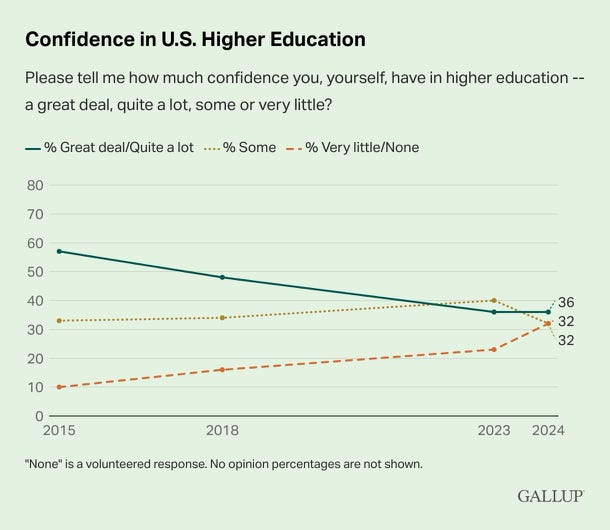
Affirmative action in academia likely contributes to declining public trust in higher education—though it’s hardly the only factor, and ideological homogeneity may be more significant. According to Gallup, the percentage of American adults who have a “great deal” of confidence in higher education has declined from 58% to 36% over the last decade. This is especially worrying given the coming demographic cliff, along with the inevitable disruption of academia by tech. From the perspective of public trust, it’s easier to defend increasing the competition than picking winners.
To be sure, embracing the Compact with the Trump administration is foolish. No sensible person would expect them to act in good faith. Their aim is not to improve universities but to bring them to heel. My academic friends are more open-minded than most, but none think cooperating is remotely a good idea.
Long term, however, we do need a policy that restores trust and safeguards public investment in academia—perhaps as Danielle Allen argues through an alternative deal achieved through bipartisan congressional effort. We shouldn’t sign their compact; we should draft our own. Such a document would outline policies that eliminate discrimination; prioritize pipeline reforms; seek evidence for key empirical claims; and embrace a more pluralistic intellectual culture.
In any case, the choice is clear. We can renounce affirmative action in favor of interventions targeting the academic pipeline—or we can credibly justify it with transparent and unbiased studies about its effects on research and teaching. Wherever we land, we need to find our way there on terms that are our own but also justifiable to others.
"In one study researchers gave biology and physics faculty otherwise identical CVs but altered the candidate’s name to manipulate perceptions of race and gender. Women and people of color were rated less competent and less hirable."
Considering the existence of affirmative action in all stages of the academic ladder, shouldn't such bias be justified? As in, if someone has a prestigious fellowship on their CV, is it not unreasonable to conclude that the ability required for them to receive it was lower if they fit certain demographic criteria (not saying they were actually less qualified than white men who also received said fellowship, only that the threshold was lower for them and therefore them receiving it tells us less about their ability). A more insightful study would take a direct product of someone's ability rather than CV proxies for it, by (e.g.) having professors evaluate the same research paper with the name switched.
I think there’s a stronger argument for affirmative action, which you haven’t discussed. It’s the fair start defense, as elaborated by Kenneth Kimma in this 2001 article: https://www.jstor.org/stable/25074498 .
Basically, if certain groups have faced discrimination when they were kids, their accomplishments to date won’t be as impressive as groups that haven’t faced that discrimination. But in that case their past accomplishments won’t be as good predictors of their future success as other metrics might be, and even if all you care about is merit it can still be useful to give those discriminated-against groups a boost.
It’s like giving a boost to a kid whose only books in the house were the Bible and Reader’s Digest—if their verbal scores are still in the same ballpark as the kid who grew up as the child of two literature professors, then arguably they’ll be just as good or maybe even stronger going forward.
(This is different from your equality of opportunity argument, which instead trades equality against merit.)
In my mind this is the strongest argument in favor of affirmative action, stronger than justice (“previous generations of these groups were wronged in the past, so now we rectify that wrong by giving members of present generations of the group a boost”) and stronger than diversity.