

In some circles, just using the word “woke” will brand you as a reactionary. But whatever term we use, we need some way to talk about rapid changes in left-wing political culture over the last fifteen years. At the risk of oversimplifying, I’ll divide these changes into two main strands.
First of all, progressives began to pay more attention to sexism, racism, and other forms of social injustice. Sexual assault (#MeToo) and racism in the criminal justice system (#BLM) took center stage. So far so good, yet many progressives also adopted radical positions and policies. They defended looting, eliminated advanced math classes, pursued aggressive affirmative action, advocated for abolishing the family, and removed necessary guardrails on youth gender medicine. Most conspicuously, they sought to defund the police—ignoring how much marginalized communities rely on policing for safety. You can guess I’m not very sympathetic: besides alienating normies, these ideas are just bad on the merits. But bad isn’t the same as beyond the pale. Many woke views are well within the range of reasonable debate.
Progressives didn’t just take up new moral and political views; they also enforced a narrow Overton window around them. People who didn’t toe the line, sometimes in trivial ways, faced public shaming, pile-ons, “cancellation,” and other informal censure. Formal censure too. The pollster David Shor was fired for highlighting evidence that peaceful protest is more effective than violent protest. Academics tried to get a feminist philosophy journal to retract an article by Rebecca Tuvel because she compared being transgender with being transracial. If you’re not sure whether these stances toward disagreement were unreasonable, you’re already lost.
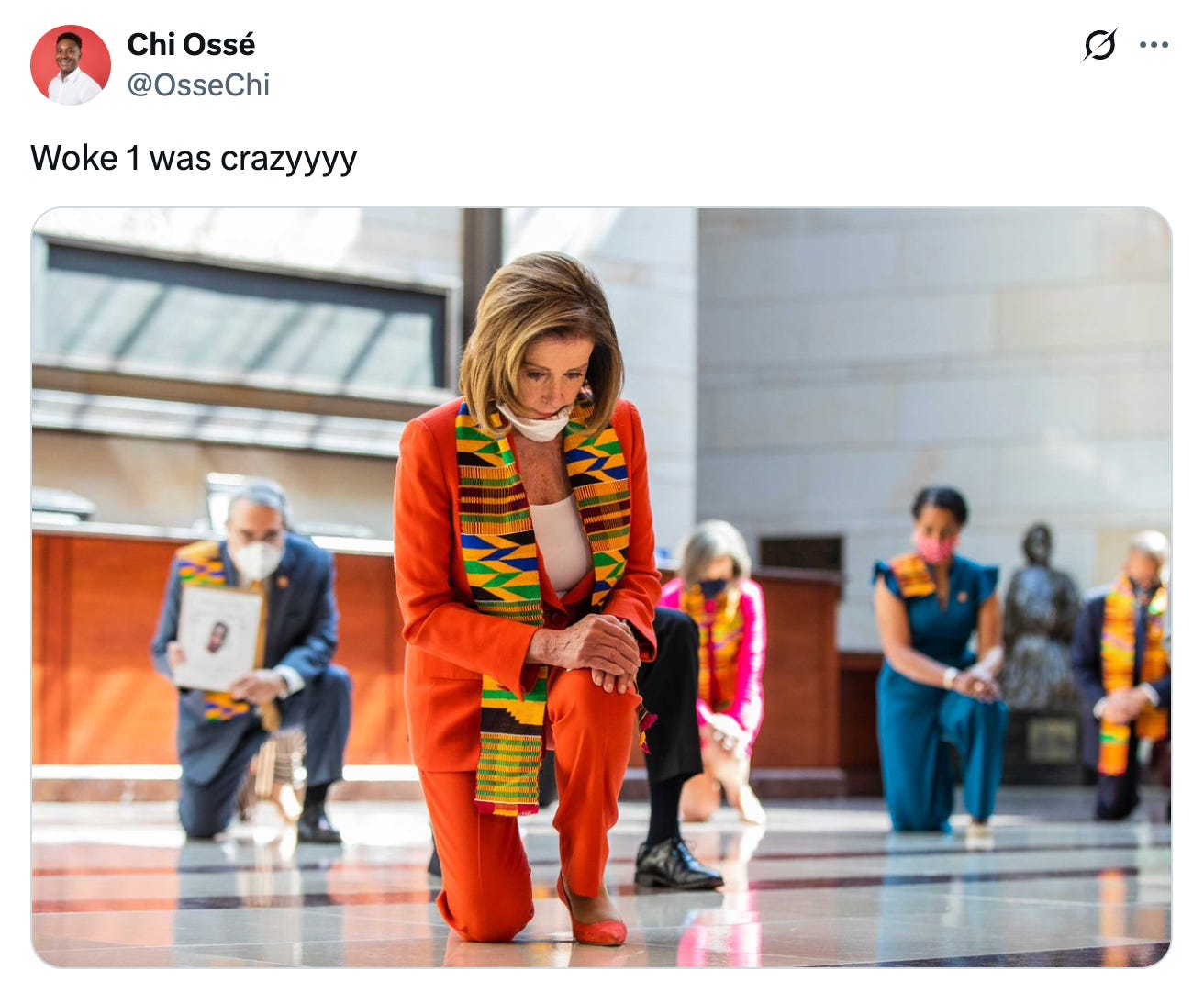
After Trump won a second term, Americans underwent a vibe shift. Sensing public blowback, progressives backed off from some of their most radical positions. Campaigning to become mayor of NYC, Zohran Mamdani announced he had no intention of defunding the police. Before narrowly losing the Democratic nomination for governor of Wisconsin, Francesca Hong recanted her opinion that Thanksgiving should be canceled.
Positions may have evolved, but the appetite for censure hasn’t. It has just shifted to other topics.
Woke 1.5 is about Gaza. It’s not enough to condemn the occupation. You must also believe that Israel is committing a genocide. You can’t say Israel was justified in mounting some kind of military response to Oct. 7, not unless you bend over backwards to add that the response it chose was disproportionate and extremely harmful. Criticism of student protesters, even just their tactics, is forbidden. Again, some woke positions on Gaza and Israel are reasonable, even if mistaken. What’s not reasonable is intolerance and punishment directed toward anyone who disagrees.
And now, progressives have found a new cause: AI.
AI critics sometimes take positions that defy the evidence—that data centers are consuming vast quantities of water or that chatbots are flooding the public sphere with misinformation. Some academics published an open letter suggesting these harms are similar to those perpetrated by oil companies and social media platforms.
To be sure, many critical positions on AI are worth taking seriously. Maybe LLMs are replacing creators and depleting our cultural commons. Or maybe the threat AI poses to workers and higher education really does justify opposition to the companies behind the technology. These are open questions. The problem, again, is the enforcement machinery that accompanies these positions.
If you think AI can improve research, reduce poverty through economic growth, or cure diseases, many on the left will dismiss you as a corporate shill—even if you also think AI risks cognitive atrophy, disempowerment, and cyberterrorism.
You’re not safe even if you’re “one of us.” In fact, being left-wing makes you more vulnerable. Hank Green made a series of anti-AI videos on YouTube. Then he was caught using ChatGPT to research one of them. His fans were so outraged that he preemptively canceled himself, pausing his channel.
AI isn’t polarized the way policing was. But attitudes elsewhere on the political spectrum are beside the point. That the far right tries to censure anyone who isn’t rabidly anti-Israel doesn’t change what the left is doing.
For now, it’s true, you can be pro-AI in some progressive circles without being excommunicated. No one (to my knowledge) has been fired for making pro-AI statements. But here’s why I think AI will get fully swept up.
Positions adopted during Woke 1 often aligned conveniently with advocates’ interests. During the pandemic, many progressives insisted on strict social and economic restrictions, in part because those restrictions didn’t threaten their livelihoods as laptop workers. If you’re relatively wealthy and privileged, drawdowns in policing won’t make you less safe. Migrants won’t compete for your jobs or strain public services that you rely on.
The drivers of woke thought and discourse are left-wing cultural elites—academics, journalists, artists, and so on. And AI is a direct threat to their livelihoods and social status. It’s disrupting higher education while automating writing and other creative work. AI might well increase economic productivity, driving abundance, but cultural elites will still lose out. This motivates them to swallow weak criticisms of AI and shun anyone they regard as the enemy.
Here we go again. Woke 2 will be crazyyyy.
Thanks to Jacob Barrett and Josh May for feedback.
I don't know how to operationalize it but I think I'd bet against this. For one, I think AI is just too orthogonal to familiar left/right divides for views on AI to end up functioning as shibboleths in left-wing spaces.
And just empirically, look at how university administrations are already reacting to AI. You've got lots that are already trying to position themselves to take advantage of AI, talking about adapting pedagogy for AI, etc. For example, Yale now has an "AI Czar." I'm on a grant application with senior colleagues where part of the plan is to do various workshops with people in the AI industry. We haven't gotten it (yet?) but the fact that we'd even think to apply strikes me as pointing to a notable contrast; during woke 1.0, did you have any university central administrations making a big show of opening new centers for the study of policing that would involve dialogue with this or that police department? Can you imagine professors applying for (let alone getting) grant money for that sort of project? It's hard to imagine. To be clear, I think there's plenty of skepticism about AI in these quarters, plenty of people (reasonably!) worried about harms and discussing what to do about them; I don't mean to represent all this as unvarnished cheerleading. But I do mean for it to show that people regard the questions as tricky, and regard knee-jerk extreme positions--"have nothing to do with it!"--as non-starters.
My overall sense is that AI is viewed by too many people as an unstoppable juggernaut, and while you'll certainly have people on the left--yes, the same sort of people who most enthusiastically participated in woke 1.0--who think we ought to completely ban the technology, treat it like Sauron's ring, etc., they won't end up being able to wield the kind of institutional power necessary to rival the absurdities of woke 1.0.
Sadly, I think your thesis is 100% correct.
Hank and John Green have done so very much good for the world. And yet....
People's priorities are just whack.